Present research & support a view

Bring your skills together in researched writing and discussion. Present a person’s contribution, consider an educational problem and support your response with relevant details.

See how a pattern changes the meaning.
عَلِمَhe knew
عَلَّمَhe taught
تَعَلَّمَhe learned
Related verb patterns express knowing, teaching and learning. At this level you examine what added letters do to meaning, then apply the forms in context.
A glimpse of what you’ll learn

What you’ll study.

Illustrative scene of a man listening and taking notes at his home desk

Present a person’s life and contribution

  • Read and listen to accounts of influential people, identifying their background, education, important events and contributions.
  • Prepare a spoken presentation explaining a person’s standing and achievements, then give your own view with supporting details.
  • Gather facts and select significant incidents for a short biography, organizing an introduction, life account and concluding reflection.
  • Write a separate thank-you letter with an appropriate opening, clear purpose and respectful closing; review your writing with a partner.
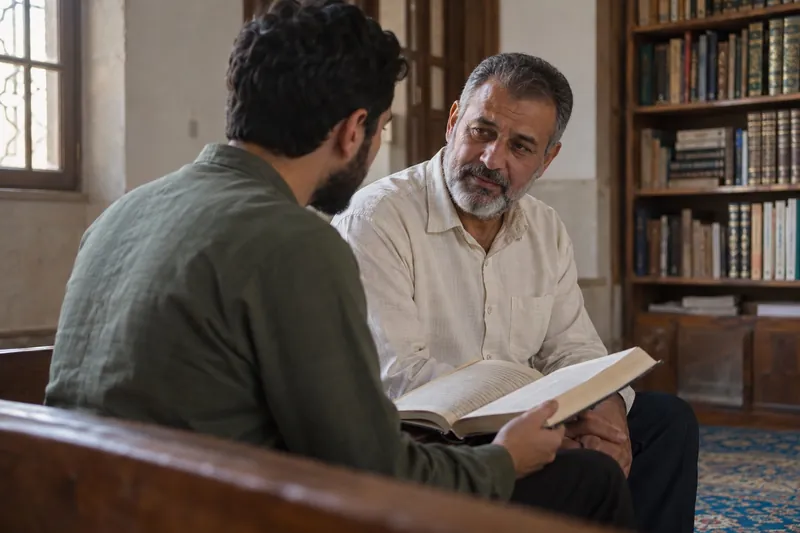
Illustrative scene of a younger and an older man discussing a book

Discuss a learning problem and a response

  • Discuss qualifications, the role of teachers and the relationship between education, work and personal experience.
  • Compare views on learning, explaining benefits, difficulties and how a problem was addressed.
  • Read educational texts and follow spoken accounts, identifying the main point and the details that support it.
  • Write connected paragraphs about a teacher’s contribution and an educational problem with a proposed solution, using the linking expressions studied.
صَرْفٌ

Ṣarf · word forms

  • Distinguish verbs that take an object from those that do not, and explore the meanings of augmented verb patterns.
  • Study maqṣūr, manqūṣ and mamdūd noun forms and make nisba adjectives to express an association.
نَحْوٌ

Naḥw · sentence structure

  • Use tamyīz to clarify a quantity, comparison or description.
  • Study categorical negation with lā and express exceptions with illā, ghayr, siwā and related forms.

By the end of ARB 113,
you should be able to…

Speaking

Present a contribution and explain your view

Give a structured account of a person’s background, achievements and influence, adding reasons for your view. Compare educational experiences and opinions, describe a difficulty and explain how it could be addressed.

Listening

Follow biographical and learning accounts

Identify a person from the biographical details given in the material. Follow a story about learning, pick out the events and main message, and use relevant details when discussing what you heard.

Reading

Connect ideas with their supporting evidence

Read a biography or text about teaching and distinguish its main ideas from supporting events and examples. Explain the person’s contribution or the educational point being made, using details from the text to support your answer.

Writing

Write for different purposes

Use gathered facts to write a short biography with a clear structure and concluding reflection. Write a thank-you letter and a paragraph proposing a solution to an educational problem, choosing suitable openings, links and endings and revising the language.


Your starting point and next step.

Before this level

Explain ideas with examples, interpret familiar expressions in context, and write connected paragraphs with a clear main point.

Find your starting level

How your progress is reviewed

Your work across the level shows how well you can interpret a text, explain your view in discussion and develop an argument in writing.

Your sessions and level reviews

Your learning materials

Reading materials, audio and video, interactive exercises, and vocabulary flashcards.

Wondering where to start with Arabic?

Talk through your goals, your starting level and how live classes could fit into your week.