
How you’ll learn
Arabic with Hiwar.

Understand Arabic, use it with your teacher in live online sessions and build on it through regular practice. Immersion, structured grammar study and clear feedback develop your listening, speaking, reading and writing together.

Illustrative scene of friends enjoying a conversation at a Cairo café

How will I understand
and use Arabic?

We use research-supported learning methods to help you remember Arabic and use it accurately. Here’s what they are—and how we use them at Hiwar.

Research-supported method

Retrieval practice

Recall Arabic from memory to practice finding the words when you need them.

An example from class

  1. Read a short exchange about a family and pick out the words for the people in it.
  2. Close the book. Use a family photo to introduce someone without the words in front of you.
  3. Write a sentence about a different relative from memory, then check the word you needed.

Illustrative detail of hands reading an open Arabic text
Research-supported method

Spaced practice

Return to what you’ve learned over time to help it stay in your memory.

An example from class

  1. Start with a question about prices in a shop dialogue.
  2. Return to the same question later in the week when you write a shopping list and ask what an item costs.
  3. Use it again in a later travel lesson to ask about a ticket. The setting changes, so you have to find the words again.
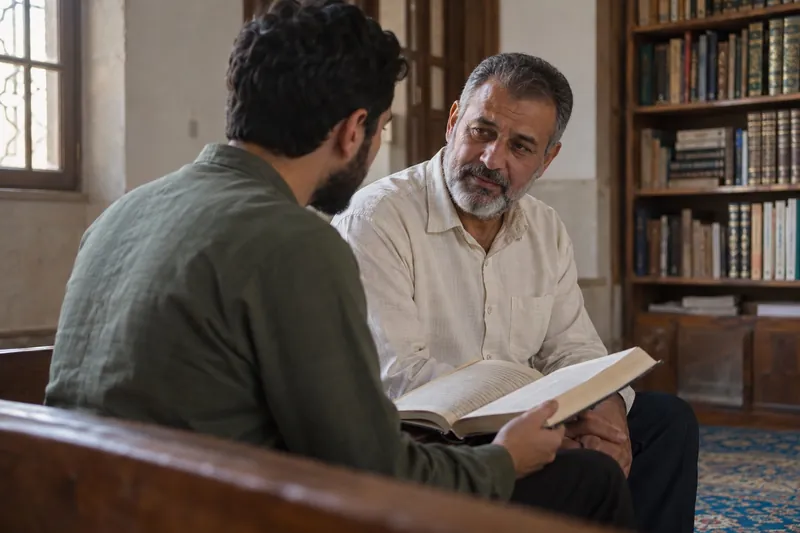
Illustrative scene of two men reading and discussing a book together
Research-supported method

Corrective feedback

Notice what needs work and practice a correction to use Arabic more accurately.

An example from class

  1. Speak while your teacher listens.
  2. Notice the sound or sentence your teacher helps you correct.
  3. Try again and use the correction in your response.
Illustrative scene of friends practicing conversation at a café

New to Arabic? Your teacher uses clear examples and can explain in English, then encourages you to practice in Arabic.

The research behind these methods

Retrieval practice. In two vocabulary experiments, recalling foreign-language words led to better comprehension and production than repeating them after a model. Kang, Gollan & Pashler (2013)

Spaced practice. A meta-analysis of 48 second-language experiments found that spreading practice over time improved learning compared with concentrating it into one block. Kim & Webb (2022)

Corrective feedback. A meta-analysis of 15 classroom studies found lasting benefits from oral corrective feedback for the language features being taught. Lyster & Saito (2010)

These studies evaluate learning techniques, not Hiwar’s program. Their findings do not establish a fixed time to fluency.

How to remember more of the Arabic you learn

How will I learn Arabic grammar?

Your teacher explains a pattern, then helps you use it to say something of your own.

Ṣarf
Learn how words change. Verb endings tell you who did something. Roots and patterns help you recognize related words.
Naḥw
Learn how words fit together. Build sentences that show who did what, or who something belongs to.
Grammar examples by level

Ṣarf. Study past-tense endings in ARB 104, verbal nouns in ARB 106, and roots and patterns in ARB 110.

Naḥw. Study noun sentences and possession in ARB 103, then verbal sentences and agreement in ARB 105.

How you’ll study ṣarf and naḥw

What will I read and write?

You might read about a family, then describe your own. Later, you might read a job listing and use what it asks for to write a CV in Arabic.

See the full curriculum
Reading
Start with letters and vowel marks. As texts get longer, read for meaning and learn to recognize figurative language.
Writing
Build from sentences to a paragraph about your family, an email about a vacation, and eventually a researched biography.
Reading and writing examples by level

Reading. Explore letters and vowel marks in ARB 101 and cultural texts in ARB 112.

Writing. Write a family paragraph in ARB 102, a vacation email in ARB 104, a CV in ARB 108 and a researched biography in ARB 113.

What happens between
my live sessions?

Practice throughout the week

Your portal keeps homework and assignments together. Use the Arabic from your lessons regularly, and bring questions back to your teacher.

Plan your practice week

Your Student Support Assistant

Your assigned SSA follows up with you and responds to questions about your sessions, assignments and portal. You know who to contact throughout the program.

New to reading Arabic?

In Reading 101, you’ll learn the letters and vowel marks and practice sounding out words aloud. You can take this course before ARB 101.

Explore Reading 101

How will I know I’m ready for the next level?

What can you understand in class? What can you say or write on your own? Hiwar’s academic team considers your work throughout the level, along with your teacher’s feedback, to decide when you’ve met the learning goals and are ready to move on.

Each new level builds on the language you can already use, with more detailed reading, writing and discussion as you progress.

See what you’ll learn at each level
  1. Introduce yourself.

    Tell your teacher your name and where you live in Arabic.

  2. Introduce someone else.

    Now introduce your brother or sister. Change the words for the person you’re talking about.

  3. Keep the conversation going.

    When your teacher asks where your sister lives, answer without looking at the example. Then ask about your teacher’s family.

What progress in Arabic looks like

How do I get started?

Here is how we find your starting point and get you ready to learn.

  1. Assessment & placement

    Find the right starting level.

    Receive your placement exam link by email. Complete written answers and oral recordings within three days of signup, pausing and returning as needed.

    A Hiwar academic advisor manually reviews your work and recommends a level. A live interview may help clarify your placement.

    Book My Assessment

    Your $50 assessment fee goes toward full-program tuition when you enroll.

  2. Enrollment

    Choose your full-program payment plan.

    Review the tuition, payment options and expected study commitment. Choose the arrangement that fits you and complete your registration.

  3. Your track & schedule

    Choose the way you’ll learn.

    Join a cohort of up to four learners for shared practice and a fixed weekly timetable. Or choose a 1:1 track with your teacher’s full attention and 24/7 scheduling across time zones. We confirm your start date and schedule after registration.

  4. Onboarding

    Get set up before you begin.

    Set up your student portal, meet your Student Support Assistant and learn how sessions, homework and assignments work. Cohort learners attend onboarding together.

  5. Your first class

    Start your classes.

    Join your teacher at your scheduled time and begin working in Arabic at your starting level.

Start at the
right level.
Build from there.

Find where to begin, or talk through your goals with an advisor.

Take your placement exam.

Get a starting-level recommendation from a Hiwar academic advisor.

Book My Assessment

Apply to study at Hiwar.

Tell us about your goals and schedule. If the program fits, you can speak with an advisor.

Speak to an Advisor