Build the Arabic
you want to use.

Study Modern Standard Arabic (Fuṣḥā) online with a native teacher. Begin at your assessed level and develop your listening, speaking, reading and writing together.

Illustrative scene of friends enjoying a conversation at a Cairo café

Explore your Arabic learning path.

See what each level helps you do, the ṣarf and naḥw behind it, and the writing you’ll practise. Open any level for its full learning goals.

ARB 101 to ARB 105

Build your first sentences.

  • Read and write Arabic letters and familiar words.
  • Introduce yourself, ask questions and describe your day.
  • Study ṣarf and naḥw, then use them in sentences and short, guided writing.
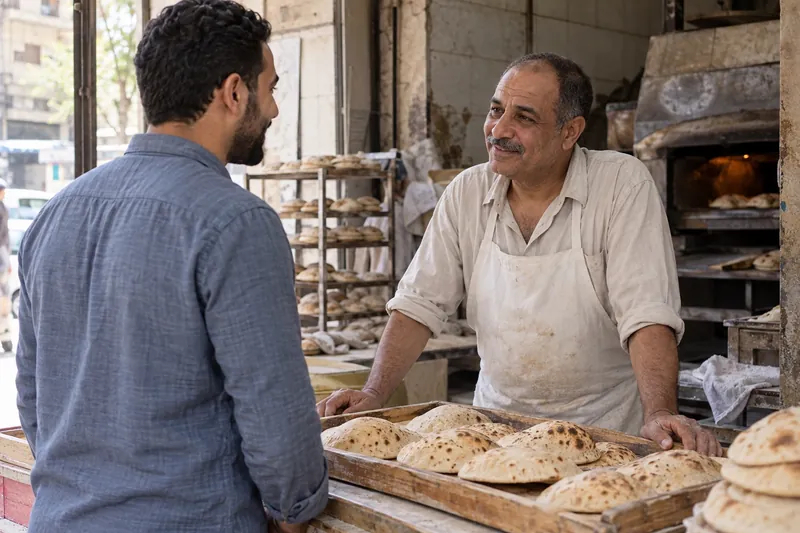
Illustrative scene of a customer greeting a neighbourhood baker
Reading101

Read your first Arabic words

If you don’t read Arabic yet, you can begin here. Reading 101 is a separate course before ARB 101. You’ll learn how letters and vowel marks work together and practice reading short words aloud.

  • Letters and sounds
  • Joining letters
  • Vowel marks
Explore Reading 101
ARB101

Read, write & introduce yourself

Connect the Arabic you read with words you can use. Build everyday vocabulary, ask simple questions and write your first introductions.

  • Build an everyday vocabulary
  • Connect sounds with written words
  • Turn words into simple sentences
  • Start a short conversation
Sentence foundations
Use “this,” personal pronouns and simple questions to describe people and things.
Writing practice
Personal details, familiar words and short model sentences.
Explore ARB 101 What you’ll study · What you’ll be able to do

ARB102

Talk about yourself & your family

Move beyond a memorized greeting. Share personal details, describe family relationships and ask questions that keep a short conversation going.

  • Exchange more than a greeting
  • Describe the people in your family
Ṣarf & naḥw
Choose pronouns and present-tense forms for one person, two people or a group.
Writing practice
A personal profile and a family paragraph based on a chart.
Explore ARB 102 What you’ll study · What you’ll be able to do

ARB103

Make requests & explain preferences

Take part in simple exchanges about study and food. Ask for what you need, explain a preference and connect short statements in speech and writing.

  • Ask for what you need while learning
  • Talk about meals and make a choice
Ṣarf & naḥw
Build noun sentences, show possession with iḍāfah, and use request and plural forms.
Writing practice
Guided paragraphs about study and meals, plus a menu with prices.
Explore ARB 103 What you’ll study · What you’ll be able to do
ARB104

Talk about plans & past experiences

Handle times and amounts, discuss a vacation and explain what happened. Learn to change verb endings and connect events in a short account.

  • Understand times, prices and amounts
  • Describe a trip and what happened
Ṣarf & naḥw
Use past-tense forms, prepositions and time expressions to say who did what, when and where.
Writing practice
Times and amounts, followed by a planned vacation email.
Explore ARB 104 What you’ll study · What you’ll be able to do

ARB105

Describe daily life & explain choices

Describe your routine, weather and clothing in connected sentences. Explain what you do and why, while making your verbs and descriptions more precise.

  • Explain how your day unfolds
  • Describe conditions and explain your choice
Ṣarf & naḥw
Identify subjects and objects, match adjectives to nouns, and add reasons or negatives.
Writing practice
A routine or free-time account and a weather-and-clothing dialogue.
Explore ARB 105 What you’ll study · What you’ll be able to do
ARB 106 to ARB 109

Handle everyday situations.

  • Ask follow-up questions about travel, housing, health and work.
  • Follow and retell experiences in more detail.
  • Complete forms and a CV, and write longer accounts; study ṣarf and naḥw to connect sentences and form related words.
Illustrative scene of visitors talking with a shopkeeper in a Moroccan souk
ARB106

Arrange travel & describe a home

Ask for the information you need when travelling or looking for accommodation. Describe places precisely, complete practical forms and begin systematic word building.

  • Handle arrivals and accommodation
  • Describe a home and discuss renting
Ṣarf & naḥw
Use relative clauses to identify a place, dual forms for two things and verbal nouns to name actions.
Writing practice
Arrival and hotel forms, plus a planned rental advertisement.
Explore ARB 106 What you’ll study · What you’ll be able to do
ARB107

Explain problems & compare options

Explain a health concern, follow advice and compare products when shopping. Learn the sentence patterns and word forms that make these exchanges clearer.

  • Explain a health concern and follow advice
  • Compare products and explain a preference
Ṣarf & naḥw
Make comparisons, give instructions, and form words for people carrying out actions.
Writing practice
Health advice, a story continuation and recipe instructions.
Explore ARB 107 What you’ll study · What you’ll be able to do
ARB108

Discuss work & describe experiences

Explain work responsibilities, prepare a CV from a template and describe a visit. Add detail with relative clauses and distinguish doing an action from receiving it.

  • Explain work and prepare for an interview
  • Recommend a place and describe a visit
Ṣarf & naḥw
Use noun endings and relative pronouns accurately, and form passive participles such as “written.”
Writing practice
A CV template, an interview dialogue and a trip report.
Explore ARB 108 What you’ll study · What you’ll be able to do
ARB109

Tell stories & connect events

Move from short descriptions to organized accounts. Discuss sports, retell memories and use sequence, contrast and passive sentences to guide your listener or reader.

  • Discuss interests and recount an event
  • Turn a memory into a connected account
Ṣarf & naḥw
Connect descriptions through agreement and iḍāfah, and use passive verbs to change a sentence’s focus.
Writing practice
Planned paragraphs about a sport and a personal memory.
Explore ARB 109 What you’ll study · What you’ll be able to do
ARB 110 to ARB 113

Explain and support your ideas.

  • Discuss traditions, history and ideas with reasons and examples.
  • Understand familiar idioms and meaning beyond the literal words.
  • Apply more advanced ṣarf and naḥw in organized comparisons, reports and essays.
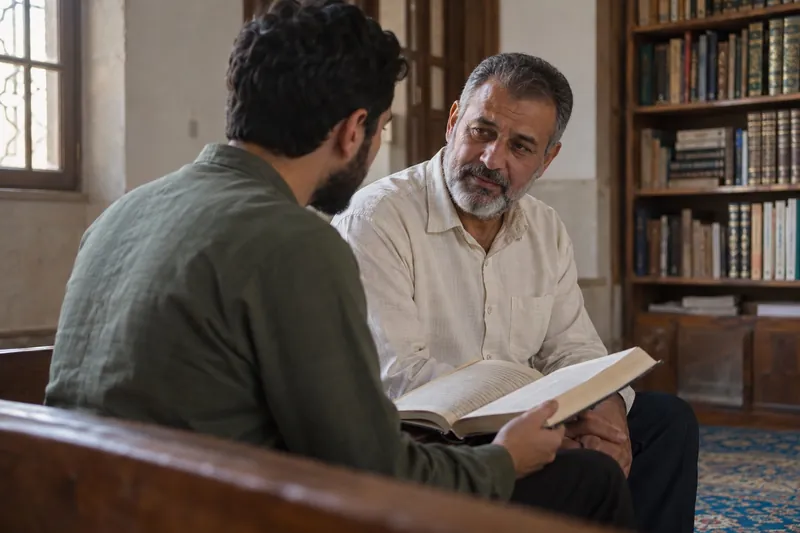
Illustrative scene of two men reading and discussing a book together
ARB110

Describe people & compare traditions

Describe appearance and character, discuss religious occasions and organize comparisons. Use roots and word patterns to understand related vocabulary.

  • Describe someone beyond their name
  • Explain traditions and compare occasions
Ṣarf & naḥw
Connect related words through roots and patterns, and study how noun and present-tense endings change.
Writing practice
Planned comparisons of two people and two religious occasions.
Explore ARB 110 What you’ll study · What you’ll be able to do
ARB111

Retell events & explain an issue

Make an account clearer through sequence, detail and description. Work with humorous stories and environmental texts while developing longer writing and more complex verb forms.

  • Retell a story so the point is clear
  • Explain an issue using information
Ṣarf & naḥw
Add descriptive detail with ḥāl and practise the changing forms of weak and doubled verbs.
Writing practice
A planned event account and a report using gathered information.
Explore ARB 111 What you’ll study · What you’ll be able to do
ARB112

Explain expressions & develop ideas

Go beyond a literal translation. Discuss cultural practices, explain proverbs in context and develop your own ideas through connected paragraphs and conditional sentences.

  • Compare customs and explain an experience
  • Understand what an expression means in context
Ṣarf & naḥw
Build conditional sentences and fuller descriptions, and form nouns for places, times and tools.
Writing practice
A language-learning essay, a poetry paraphrase and dialogue using proverbs.
Explore ARB 112 What you’ll study · What you’ll be able to do
ARB113

Present research & support a view

Bring your skills together in researched writing and discussion. Present a person’s contribution, consider an educational problem and support your response with relevant details.

  • Present a person’s life and contribution
  • Discuss a learning problem and a response
Ṣarf & naḥw
Clarify meaning with tamyīz and exceptions, and study how added letters change a verb’s meaning.
Writing practice
A short researched biography, a thank-you letter and a proposed solution.
Explore ARB 113 What you’ll study · What you’ll be able to do

Build on the Arabic you already know.

Your placement exam helps us recommend the right level. A Hiwar academic advisor reviews your written answers and oral recordings. If the script is new to you, Reading 101 prepares you to begin ARB 101.

How your placement exam works
One exam.
Written + oral.
Your written answers
Your oral recordings
Manually reviewed by
a Hiwar academic advisor
Book My Assessment

Choose the setting that helps you learn.

Learn with a native Arabic teacher who can clarify in English. Lessons combine speaking, listening, reading and writing, with grammar taught through the language you use.

Cohort track

Up to four learners, with a shared level and regular timetable.

  • Practice with classmates and learn from each other’s questions.
  • Get time to speak, receive feedback and be heard.
  • Build a steady routine with a group working toward the same next level.

1:1 track

Learn one-to-one with your teacher.

  • Keep your teacher’s full attention on your learning.
  • Have more room to arrange days and times around your availability.
  • Work through questions and difficult material with focused guidance.

Choose your session times with 24/7 scheduling. Hiwar confirms your regular timetable before you begin.

Support for your learning.

Hiwar World clubs & labs

Practice freestyle conversation, Arabic sounds and natural speech flow in live sessions. Ask your advisor what access comes with your plan.

Explore the clubs and labs

Your assigned assistant

Onboarding gets you ready to join sessions and complete assignments. Your Student Support Assistant stays with you throughout the program to follow up and help with questions.

Your onboarding and support

When are you ready for the next level?

Hiwar’s academic team looks at your work throughout the level and considers your teacher’s feedback. You advance when you’ve met the level’s learning goals.

How level reviews work

Know the time, cost and flexibility.

Your schedule and pace

Choose session times in your time zone with 24/7 scheduling. We confirm your regular timetable and practice commitment before you join. Program length depends on your starting level and pace.

Your tuition and payment plan

Review the full-program tuition and available payment plans with an advisor, then choose the plan that suits you. Your paid $50 assessment fee goes toward tuition when you enroll.

Understand tuition and payment plans