Talk about yourself & your family

Move beyond a memorized greeting. Share personal details, describe family relationships and ask questions that keep a short conversation going.

Talk about your family—or ours.
هَذِهِ عَائِلَتِي.This is my family.
هَذِهِ عَائِلَتُنَا.This is our family.
Attached pronouns change “my family” to “our family.” You use these endings when describing relationships.
A glimpse of what you’ll learn

What you’ll study.

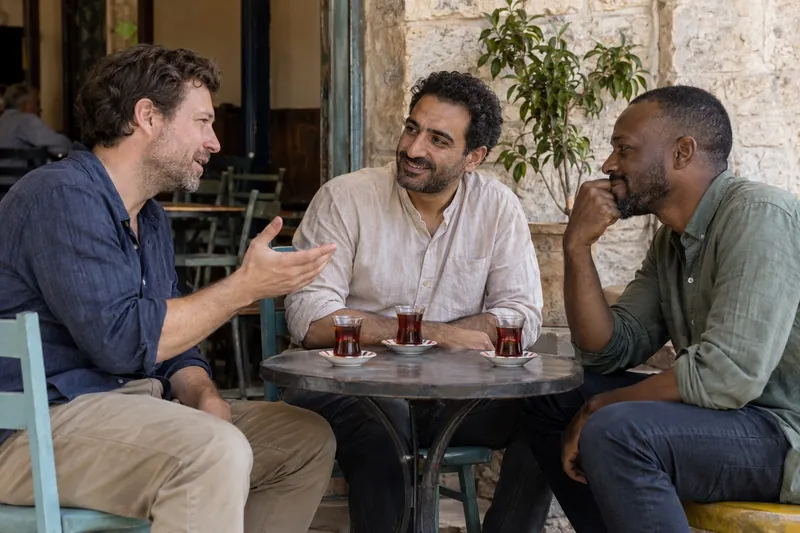
Illustrative scene of three men exchanging ideas over tea

Exchange more than a greeting

  • Exchange names, nationalities, ages, occupations and where you live, and ask another person for the same details.
  • Ask questions about someone else and use personal pronouns and present-tense forms in your answers.
  • Read short personal profiles and identify details such as age, work, address and contact information.
  • Record your own personal details and practise introducing another person from the information you have gathered.
Illustrative scene of four men talking around a shared meal

Describe the people in your family

  • Learn family relationships and ask about relatives’ names, ages and occupations, including in a family gathering.
  • Use attached pronouns for “my,” “your” and “our,” and distinguish one person, two people and a group.
  • Follow family descriptions and question-and-answer exchanges, then tell someone what you learned about another family.
  • Organize relatives in a family chart and use it to write a short, connected paragraph with a model.
صَرْفٌ

Ṣarf · word forms

  • Change present-tense verbs to match who is acting: one person, two people or a group.
  • Form masculine and feminine nationality adjectives when introducing people.
نَحْوٌ

Naḥw · sentence structure

  • Use personal and attached pronouns to show who you mean and whose family you are describing.
  • Match demonstratives to masculine, feminine, singular, dual and plural nouns.
  • Ask for personal information and quantities using question words, including “how many?”.

By the end of ARB 102,
you should be able to…

Speaking

Introduce people and ask about their lives

Share your nationality, age, occupation and where you live, then ask for the same information. Describe your family and introduce someone else, using the pronouns and present-tense forms practised in the level.

Listening

Pick out personal and family details

Identify who is speaking or being described in a short, familiar exchange. Pick out names, personal details and family relationships, and use that information to answer questions.

Reading

Understand profiles and family descriptions

Read short profiles and find a person’s age, nationality, occupation or contact details. Follow a family description and work out who the pronouns refer to and how the people are related.

Writing

Introduce yourself and your family in writing

Record personal information in the appropriate fields. Use a family chart and a model to write a short paragraph describing relatives, their relationships and familiar personal details, with suitable pronouns and noun forms.

Your starting point and next step.

Before this level

Recognize Arabic letters, read familiar words, and give a basic personal introduction.

Find your starting level

How your progress is reviewed

Your work across the level shows how well you can follow short dialogues, read familiar texts and write about everyday topics.

Your sessions and level reviews

Your learning materials

Reading materials, audio, interactive exercises, and vocabulary flashcards.

Wondering where to start with Arabic?

Talk through your goals, your starting level and how live classes could fit into your week.