 U.S.-based institute
“The teachers are incredibly supportive and they make learning Arabic so easy and enjoyable.”
A
Read their storyAisha K.Student

Understand more of the Qurʾān and use Arabic confidently when you travel, work or live in an Arab country. In live classes of up to four, a certified native teacher gives you feedback as you speak, read and write.




You can watch every video, fill notebooks with rules and still freeze when it is your turn to speak. Your next program should change what you can do.
The old wayMore content. The same frustration. | The Hiwar wayLive practice. Clear feedback. Progress you can use. |
|---|---|
A recording cannot hear you.Replay the explanation ten times. The video still cannot answer your question or correct the sentence you are trying to say. | Learn with a teacher who responds.Your main sessions are live. Ask the question, say the sentence and get feedback while you are working with the language. |
“Interactive”—but you barely speak.Clicking answers and watching the teacher talk are not conversation practice. In a crowded session, your turn can be over before you find your words. | Have room to speak, not just attend.Learn in a cohort of up to four or a 1:1 track. Practice your own answers, ask follow-up questions and work through mistakes with your teacher. |
The same ṣarf and naḥw. Another year.Repeating terminology and verb tables without applying them can leave you recognizing rules, yet unable to use them when you need them. | Put every rule to work.Study ṣarf and naḥw through clear explanations and examples, then apply them in listening, speaking, reading and writing. Build Arabic you can use beyond an exercise. |
Miss a week. Nobody follows up.When attendance and assignments are left entirely to you, a busy week can become a long break. Another video will not get you back on track. | People help you stay accountable.Your teacher sets work and gives feedback. Your assigned Student Support Assistant follows up on attendance and assignments, and helps when you get stuck. |
A finished playlist is not fluency.Watching the last lesson or ticking off a quiz does not show whether you can follow a conversation, explain an idea or write a clear paragraph. | Move forward when you can use it.Hiwar’s academic team looks at how you use Arabic throughout the level, with feedback from your teacher, to decide when you’re ready to advance. |
New course. Same beginner material.Starting everyone at the beginning can waste time on what you know while leaving your real difficulties untouched. | Build on your progress. Work on your gaps.An academic advisor reviews your written answers and oral recordings to recommend your starting level. Follow a connected path from there. |
Your effort deserves more than another course to finish.
See how you’ll learn with Hiwar
You know the rules, but following a conversation or finding your own words is still difficult.
At Hiwar, put the ṣarf and naḥw you know to use in guided conversation, listening, reading and writing.
Turn grammar into usable ArabicYou recognize words in the Qurʾān and want to understand more—and use Arabic with people too.
At Hiwar, connect words with meaning through Fuṣḥā reading, grammar and conversation. Build a foundation for further Islamic study.
Connect Arabic with your goals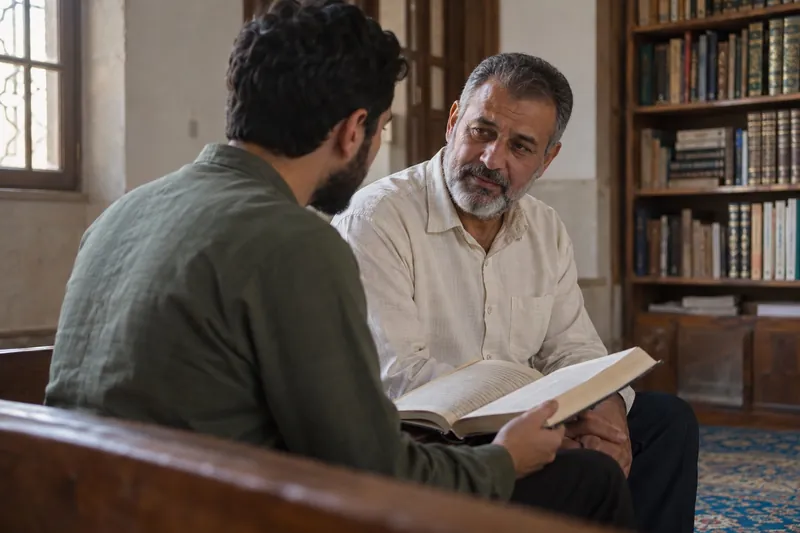
You worked through Al-Kitāb or another textbook. An unfamiliar question can still leave you searching for an answer.
At Hiwar, go beyond prepared dialogues. Practice unfamiliar questions and express your own ideas, starting from your assessed level.
Build on your previous study
Familiar phrases get you through the day. A longer conversation or written message can still feel difficult.
At Hiwar, build your Fuṣḥā beyond familiar phrases with guided practice and feedback. Discuss local dialect needs with your advisor.
Understand Fuṣḥā and everyday speech
Recognizing the right answer feels different from building a sentence when nobody supplies the next word.
At Hiwar, use your vocabulary with a teacher who listens and gives feedback. Assignments and your Student Support Assistant help you keep practicing.
Practice beyond apps and recordingsYour experience counts. Your assessment shows where to begin. Tell us what you have studied and where you still feel stuck.
Find your starting pointBuild your Fuṣḥā step by step in one connected journey. Develop listening, speaking, reading and writing alongside ṣarf (word forms) and naḥw (sentence structure), with a review before you move to the next level.


We have a course for you. In Reading 101, you’ll learn the alphabet and vowel marks, then practice reading your first words aloud.
Explore Reading 101Your course builds from one level to the next. In Hiwar World, choose what you want to practice: join a conversation with learners at different levels or work through a difficult sound with a teacher. Ask your advisor about access.
Explore the clubs and labsFind your homework and assignments in one place. Practice the Arabic from your lessons throughout the week, so learning continues between sessions.
See how homework worksYour assigned SSA follows up and answers questions about sessions, assignments and portal access throughout your program.
How your SSA supports youYour work throughout the level shows what you can do in Arabic. Hiwar’s academic team uses that work and your teacher’s feedback to decide when you’re ready to move on.
How level reviews work
A full-time job, a business, children or a degree should be part of the plan. Tell us the time you can protect; we’ll help you plan your sessions and practice around it.
Understand more, speak with confidence and build relationships in Arabic. Choose a session schedule with room for meetings, travel and life outside work.
Learning around workSchool runs, family routines and your own ambitions all matter. Choose a study window you can protect, with live teaching and a clear learning path already planned.
Learning alongside family lifePrepare for further study, deepen your connection to Arabic or open up future work. Build your plan around lectures, assignments and exam weeks.
Planning around universityThe program teaches Fuṣḥā (Modern Standard Arabic), with listening, speaking, reading, writing, ṣarf and naḥw. Regional dialects differ, so tell Hiwar if you need one in particular. Fuṣḥā can support your understanding of Qurʾānic Arabic, but this is not a specialist tafsīr or classical-text interpretation course. How Fuṣḥā fits different goals.
It is a complete Fuṣḥā program. You study ṣarf (word and verb forms) and naḥw (sentence structure) alongside all four language skills. For example, the curriculum includes noun sentences in ARB 103, past-tense endings in ARB 104 and roots and patterns in ARB 110. See every level or how grammar connects to using Arabic.
Plan for live sessions plus homework and practice. The total depends on your level and study pace; Hiwar explains it in your learning plan before you enroll. Bring two realistic study windows and include time for assignments, not only your live sessions. Questions to check before choosing a program.
There is no single deadline for every learner. Your starting level, pace, practice and progress determine the timeline. Hiwar discusses an estimated path before enrollment and reviews your progress along the way. What a realistic timeline depends on.
Hiwar explains the total tuition and available payment plans for your recommended program before you enroll. Your written offer sets out the teaching, amounts, payment dates and terms. Compare the total commitment as well as each installment. What to check in your offer.
Answer a few questions about your goals and schedule. If the program fits, you can choose a time for a video call with an advisor.
Speak to an Advisor