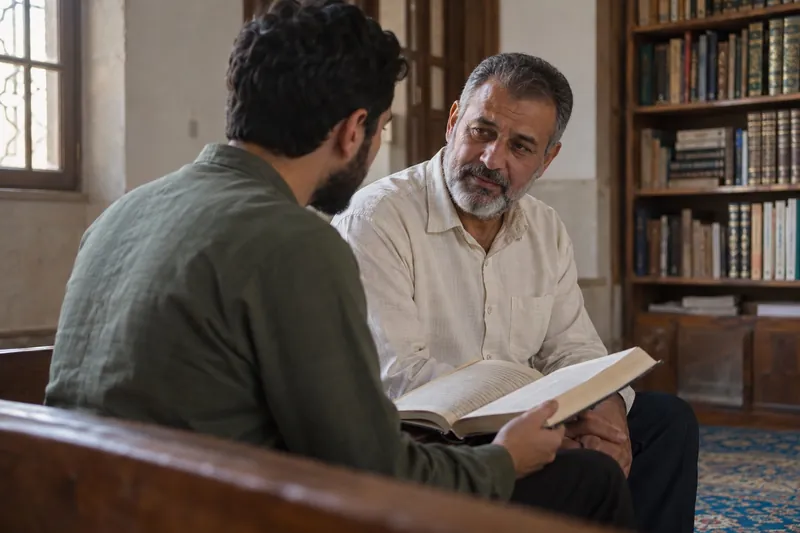
I know Arabic grammar. Why do I freeze when I speak?
Turn familiar rules and vocabulary into answers you can produce in a conversation.
Read article
Sarf explains how Arabic words change. Nahw explains how they fit into a sentence. See how you practice both through examples from Hiwar’s curriculum.
Hiwar teaches Fuṣḥā through listening, speaking, reading and writing, with ṣarf and naḥw throughout. You learn the rules, work through examples and use them in your own answers.

Naḥw helps you understand the job each word does in a sentence. In ARB 103, you study nominal sentences and possession through iḍāfah. ARB 105 develops verbal sentences, subjects, objects and adjective agreement.
You might describe your family, identify who is doing an action or explain why you made a choice. The topic gives the grammar a use.
Ṣarf covers word and verb forms. ARB 104 includes past-tense endings; ARB 106 introduces verbal nouns; ARB 110 covers roots, word families and patterns.
Recognizing a shared root can help you connect words. You still check the meaning of the whole word in its sentence.
Your teacher explains a structure, works through an example and helps you use it in speech and writing. Research on focused second-language instruction supports teaching language forms explicitly. It does not mean memorizing rules alone produces fluent speech.
Early writing uses models and prompts. Later work includes longer accounts, cultural comparisons and researched writing. The level guide shows the actual topics and intended outcomes.
Your main program covers the full curriculum. Hiwar World gives you extra conversation and pronunciation practice. Its freestyle Conversation Club is not a grammar lesson or a replacement for your program.
Turn familiar rules and vocabulary into answers you can produce in a conversation.
Read articleFind out whether vocabulary or sentence structure is stopping you from understanding what you read.
Read articleCompare what you can understand and do, and how much help you need.
Read article