I can read Arabic aloud. Why don’t I understand it?
Find out whether vocabulary or sentence structure is stopping you from understanding what you read.
Read article
Use a short recording to work out what you miss and practice hearing it in context.
A sentence may look familiar on the page and still be hard to catch when someone says it. Speech gives you less time to pause. Start with a short exchange you can check, rather than a long conversation you cannot follow.
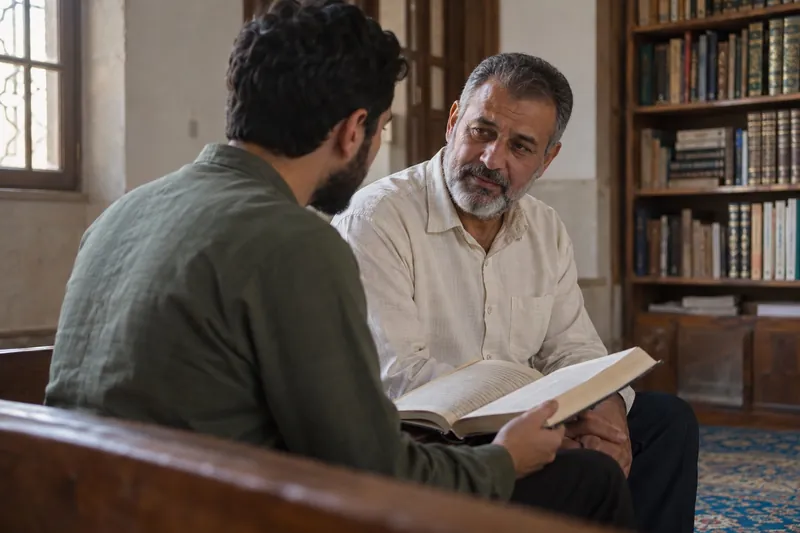
Use a dialogue at your level, ideally with a transcript or a teacher who can explain it. If every sentence contains unfamiliar vocabulary, choose something simpler.
Also check the variety of Arabic. Hiwar teaches Fuṣḥā; a regional dialect can sound different even when the topic is familiar. Fuṣḥā and dialect serve different needs.
First, listen for the situation: who is speaking, and what are they discussing? Next, listen for one detail, such as a time, place or reason. Then check the transcript.
Find a phrase you missed. Listen to it again while reading, then without the text. This helps you locate the difficulty instead of replaying the whole recording without a plan.
Ask your teacher to model a request for repetition, a slower explanation or the meaning of a word. Use it during your next exchange.
You can say, for example, مَاذَا تَعْنِي هٰذِهِ الْكَلِمَةُ؟ — “What does this word mean?” A clarification question lets the conversation continue.
Use a phrase from the recording in your next live session. Ask a question with it or answer one. If you want more interaction, Conversation Club gives you a theme to discuss with a teacher and other learners.
Measure a small change: you caught the main idea, needed fewer repetitions or answered a follow-up question. You do not need to understand every word to notice progress.
Find out whether vocabulary or sentence structure is stopping you from understanding what you read.
Read articleHow examples, English clarification and guided Arabic practice help you take part.
Read articleCombine useful solo practice with live exchanges, even when your daily life is in English.
Read article