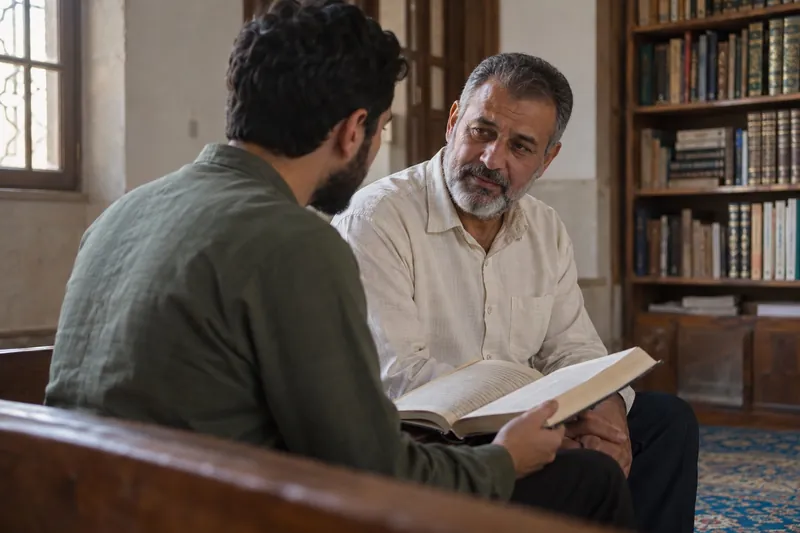
Cohort or 1:1: which Arabic track suits me?
Compare shared practice and a fixed routine with individual attention and your own timetable.
Read article
How examples, English clarification and guided Arabic practice help you take part.
All Hiwar teachers are native Arabic speakers who can communicate in English. They can clarify meaning when needed, then encourage Arabic so you get practice using what you understand.

Your placement helps establish a suitable level. A new word can be introduced through a picture, dialogue, short text or your teacher’s example.
Ask the teacher to repeat or explain when the meaning is unclear. Immersion does not mean silently sitting through material you cannot follow.
Your teacher can model a question and answer, then help you change part of it. With an introduction, you might keep the sentence pattern and add your own name or country.
Your attempt shows what you understood. A correction gives you something specific to try again.
“What does this word mean?” or “Could you say the question again?” gives your teacher a clear way to help. Ask for these expressions in Arabic and practice them.
If a whole task is unclear, explain which part you did understand. English is available for clarification; the aim is to return to Arabic practice.
You will also study grammar, reading and writing. The full program is more than conversation alone.
Explore the learning approach and read students’ own accounts of the teaching.
Compare shared practice and a fixed routine with individual attention and your own timetable.
Read articleUse a short recording to work out what you miss and practice hearing it in context.
Read articleTurn familiar rules and vocabulary into answers you can produce in a conversation.
Read article